

Choosing an Outdoor Lounge for a Coastal Home

Buying outdoor furniture for a coastal home is a fundamentally different decision to buying for a sheltered suburban backyard. The environment is more demanding. Salt air accelerates corrosion in materials that would last decades inland. UV intensity near the water is relentless. Wind carries moisture into every gap and joint.
Get the materials right and a coastal outdoor lounge performs beautifully for well over a decade. Get them wrong and you are dealing with rust, fabric degradation, and structural failure within a few years. This is what to look for.
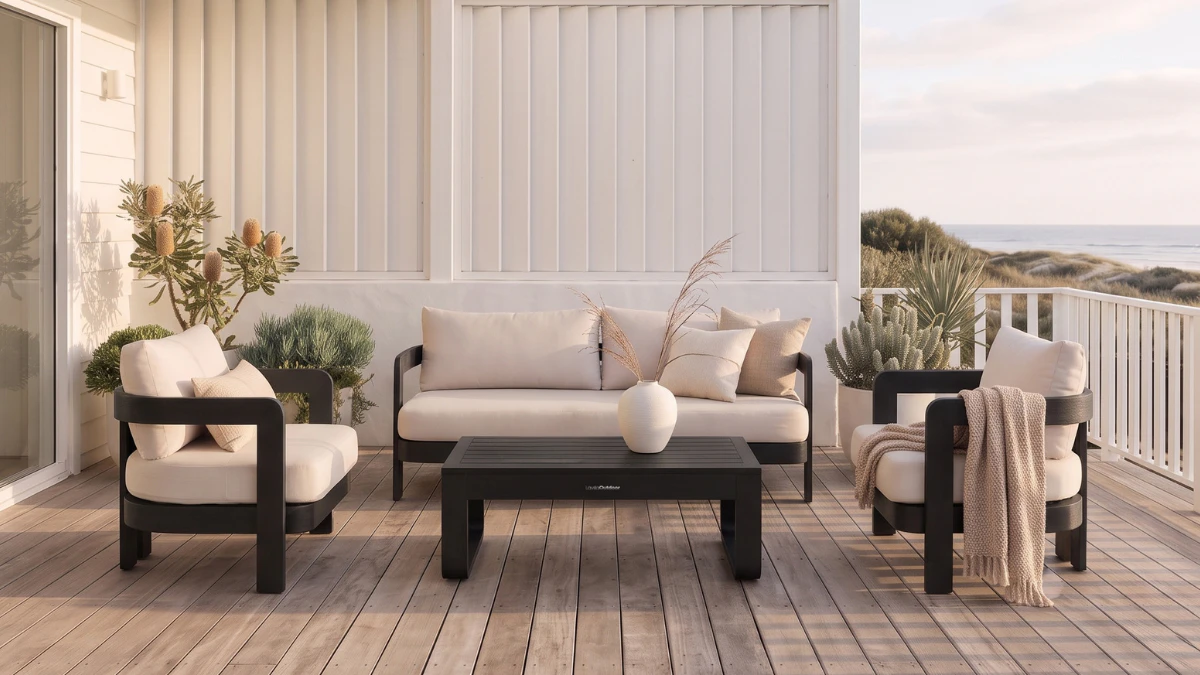
Pictured: Balmain 4pc Outdoor lounge set with coffee table in a coastal home.
What salt air actually does to outdoor furniture
Salt air is corrosive. The fine particles it carries settle on metal surfaces and accelerate oxidation. On ferrous metals such as steel and iron, this produces visible rust. On lower quality aluminium, it can cause pitting and surface degradation. On high quality powder coated aluminium, it has far less effect because the coating acts as a barrier between the metal and the environment.
The practical implication for coastal buyers is simple: only consider furniture with frames specifically rated for coastal use. That means either marine-grade stainless steel, which has the highest corrosion resistance, or powder coated aluminium of sufficient quality. The stainless steel outdoor lounge settings at Lavita Outdoor are built for exactly this application.
Fabric performance in coastal conditions
Coastal environments combine UV intensity with moisture, salt deposits, and periodic direct exposure to rain or sea spray. Fabrics that are not engineered for outdoor use fade, weaken, and develop mould within a short period in these conditions.
The two fabric types that perform consistently in coastal environments are olefin and Sunbrella. Both are solution-dyed, meaning the colour goes through the fibre rather than sitting on the surface. Both resist moisture and UV. Sunbrella is the stronger performer in maximum sun exposure. Olefin performs extremely well in the partially sheltered coastal environments that most Australian homes with outdoor living areas actually present.
Quick dry foam in the cushion core is not optional in a coastal setting. Standard foam retains water. In a coastal environment where cushions encounter salt air moisture regularly, that retained water creates mould faster than it would inland. Quick dry foam drains rapidly and resists the conditions.
What to avoid in a coastal environment
Natural wicker and rattan are not suitable for coastal outdoor use. Synthetic PE wicker built over an aluminium frame is a different matter and performs well in coastal environments with appropriate care.
If you are considering teak, build a maintenance routine into your decision. Teak's natural oils provide resistance, but direct salt air and full sun exposure accelerates weathering compared to a sheltered inland environment. The outdoor lounge settings at Lavita Outdoor include a range of configurations suited to coastal homes, with the team able to advise on which settings are most appropriate for your location.
The positioning question
Even within a coastal property, not all outdoor spaces are equally exposed. A deck directly facing the ocean is as demanding an environment as outdoor furniture encounters. A covered alfresco area on the inland side of the same property might be half as demanding.
If you are unsure how exposed your position is, the Lavita Outdoor showroom team has experience advising coastal buyers across Sydney, Wollongong, Brisbane and Melbourne. Come in with some photos of your space and the conversation will be a productive one. Find your nearest showroom.







